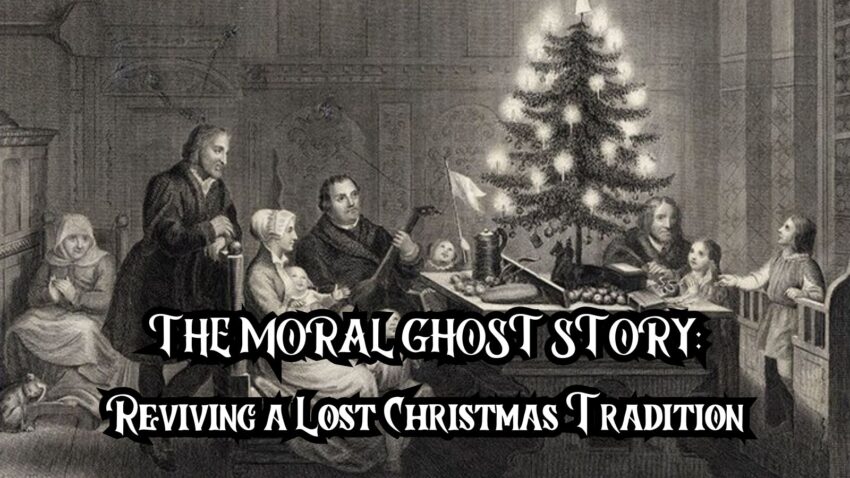
THE MORAL GHOST STORY: Reviving a Lost Christmas Tradition
When my kids were younger, Christmas Eve had a rhythm. Wrapping finished. Presents under the tree. Lights working after I spent an hour swearing at the tangle. My wife would pour wine. The kids would be bouncing off walls from sugar cookies. I’d shut off every light but the tree, and then I’d tell them a ghost story.
First time I did it, my wife looked at me like I’d grown a second head. “Christmas Eve? Really? You want nightmares?”
But my grandfather did this same thing with me. Told me something I’ve never shaken: Christmas used to belong to ghost stories. Before Hallmark made it all shiny, people huddled by fires in December dark and told each other about the dead walking back.
Look around if you don’t believe me. A Christmas Carol. M.R. James writing ghost stories meant to be read aloud at Cambridge every Christmas Eve. That song lyric about “scary ghost stories” tucked right into “It’s the Most Wonderful Time of the Year” where nobody questions it anymore.
The Victorians knew what we’ve lost. Christmas isn’t just cheer and obligatory joy. It’s the empty chair nobody mentions. The person missing from the table. The year bleeding out while you wonder what the hell you did with it. Looking hard at who you’ve been and who you’re supposed to become. All that weight needs somewhere to land, and a story where the dead come back with messages? That’s a hell of a place to put it.
We’re always hunting for new angles here at Every Writer. Ways to crack open old ideas you’ve walked past your whole life without seeing them fresh. December’s here. Year’s ending. Everyone’s thinking about family and memory and what actually matters. This is the moment for the moral ghost story.
Not horror. I don’t mean jump scares or blood. I mean the specific thing where a ghost shows up because someone breathing needs to face a truth they’re running from. The dead teaching the living how to be human.
These stories follow patterns. They’ve got rules. Understand the structure and you’ve got something that’s worked for over a century—something that feels both ancient and immediate. The kind of story that doesn’t let go.
Let me show you how to write a Christmas ghost story that lands.
>>>Download our free Moral Ghost Story Worksheet here<<<
Why Ghosts at Christmas? (The Historical Context)
Most people don’t know this, but Christmas used to scare the shit out of folks.
Not the church kind of scary. I’m talking about sitting in a freezing parlor with one candle burning while your uncle swears he saw a woman in white walking through the graveyard last January.
Victorians did December ghost stories like we do sugar cookies now. Gather the family, stuff yourself, wait for dark, then swap tales about the dead showing back up. Normal Christmas behavior.
Dickens didn’t pull A Christmas Carol out of nowhere. England had been telling ghost stories at Christmas for generations before him. Long winter nights made it easy. So did looking around the table and seeing gaps where people used to sit. Start thinking about the dead and stories come natural.
M.R. James wrote his scariest ghost stories for Christmas Eve readings at Cambridge. Not Halloween. Christmas Eve. Popular enough that decades later somebody wrote “there’ll be scary ghost stories” into a holiday song and nobody batted an eye.
The Victorians thought the barrier between living and dead got weak at year’s end. Solstice passes, darkness takes over, Christmas lands right in the middle with one foot in each year. Threshold time. Dead could walk through easier.
Here’s what matters though: these weren’t campfire scare stories. Victorian Christmas ghosts taught lessons. They didn’t come back for revenge or cheap thrills. They came back because somebody alive needed to hear truth they’d been dodging. A warning. Something buried. Reminder about what counts before the clock runs out.
Ghost wasn’t the point. Message was.
Made sense for Christmas. Holiday already drags up memory, family mess, forgiveness, old shit you can’t fix. What you give versus what you hoard. Drop a ghost into that and you’ve got someone with dead-person clarity who can skip the polite bullshit and tell you exactly what you’re screwing up.
We cleaned Christmas up eventually. Pushed the ghosts to October. Pretended they never belonged together.
But the structure’s still good. Rules still work. December’s here, everyone’s thinking about time wasted and family baggage and regret. Perfect moment to use what the Victorians figured out.
>>>Download our free Moral Ghost Story Worksheet here<<<
Section 2: What Makes a Moral Ghost Story Different
Most ghost stories want to scare you. Moral ghost stories want to fix you.
Big difference.
Horror ghosts show up to kill teenagers or possess your house or drag you to hell. They’re threats. Moral ghosts show up because you’re being an asshole and somebody dead noticed. They’re interventions.
The structure’s simple: Living person needs to learn something they’re actively avoiding. Ghost is the perfect messenger. Message gets delivered. Living person chooses what to do with it.
That last part matters. The ghost can’t force change. Can’t make you be better. All they can do is show you truth and let you decide. Scrooge could’ve told the ghosts to fuck off and gone right back to counting money. He didn’t, but he could have. That choice is what makes these stories work.
Compare that to horror. In horror, the ghost’s got power over you. It controls when you die, how you die, whether you escape. You’re helpless. In a moral ghost story, you’ve got all the power. The ghost is just holding up a mirror. What you do when you see your reflection—that’s on you.
The ghost represents whatever truth you’ve been burying. Could be that you’re cruel. Could be that you’re wasting time. Could be that someone you hurt never got over it. Could be that the life you’re building leads nowhere good. Whatever it is, you already know it somewhere deep down. The ghost just makes you look at it.
This is why ghosts work better than living characters for this job. Living people you can argue with. Make excuses to. Dismiss as jealous or stupid or not understanding your situation. Hard to dismiss a dead person. They’ve crossed over. They know what matters now because they’re on the other side of the finish line. They’ve got authority you can’t ignore.
The lessons that work best are the ones people wrestle with in real life. Forgiveness—both giving it and asking for it. Generosity versus greed. Time you’re wasting on stuff that won’t matter. Cruelty’s consequences catching up with you. Family bonds you can’t escape even when you try. Kindness to strangers mattering more than you think. The person you’re becoming versus the person you wanted to be.
Nothing abstract. Nothing theoretical. Concrete moral questions people actually face.
And here’s the thing about using death as your teacher: it clarifies everything. When you’re dying, you don’t give a shit about your car or your job title or who won the argument. You care about whether you loved people. Whether you were decent. Whether you made things better or worse. The ghost brings that deathbed clarity into your living room while you’ve still got time to change course.
That’s what separates moral ghost stories from everything else. They’re not about fear. They’re about regret you can still prevent. About seeing yourself clearly before it’s too late to do anything about what you see.
The ghost isn’t there to hurt you. It’s there to save you from yourself.
>>>Download our free Moral Ghost Story Worksheet here<<<
Section 3: Building Your Living Character
Don’t start with who your character is. Start with what they’re doing wrong.
That’s the engine. Everything else follows from that one thing they’re screwing up.
Maybe they’re ignoring their kids while chasing a promotion that won’t matter. Maybe they’re nursing a grudge that’s poisoning their whole life. Maybe they’re so focused on being right they can’t see they’re destroying their marriage. Maybe they’ve convinced themselves being alone is strength when really it’s just fear.
Pick the thing they’re getting wrong. Then build the character around it.
They need a blind spot. Something everyone around them can see but they can’t. Or won’t. Their spouse sees it. Their friends see it. Maybe even strangers see it. But they’ve got themselves convinced it’s fine, they’re fine, everything’s under control.
The blind spot makes them human instead of just some cardboard villain waiting to learn a lesson.
And they need a justification. A reason they tell themselves their behavior is okay. “I’m protecting my family by working this hard.” “They hurt me first.” “I don’t have time for that right now.” “Nobody understands what I’m dealing with.” “I earned the right to be angry.”
The justification has to make sense. Not be right, but make sense. Something a real person would actually tell themselves at three in the morning when they can’t sleep.
Where you find them at the story’s start matters too. Alone in a big empty house they worked their whole life to afford? Perfect. Forced to attend a family gathering they’ve been dreading? Even better. Working on Christmas Eve because they volunteered to avoid going home? Gold.
Put them somewhere that highlights what they’re doing wrong. Somewhere the absence or the avoidance or the waste shows up clear.
Then figure out the stakes. What happens if they don’t change?
Not in some vague future sense. Concrete. What are they about to lose? Their kid stops trying to connect. Their spouse leaves. They die alone and nobody comes to the funeral. They become exactly like the parent they swore they’d never turn into. The person who still loves them finally gives up.
Make the stakes real and close. The ghost isn’t showing up to warn them about some distant hypothetical. It’s showing up because the cliff edge is right there and they’re about to walk off it.
Your character doesn’t need to be evil. Just human. Just stuck. Just convinced they’re doing the right thing when everyone else can see they’re not.
That’s who needs a ghost. Someone who’s lost but doesn’t know it yet. Someone who could still turn around if they’d just stop walking for one goddamn second and look at where they’re headed.
>>>Download our free Moral Ghost Story Worksheet here<<<
Section 4: Creating Your Ghost
The ghost has to be personal. Can’t be some random spirit wandering through. Has to be this ghost for this person at this moment.
Figure out the connection first. Who are they to your living character?
Could be a parent. Old friend who died years ago. Former lover. Someone they wronged and never apologized to. Someone they failed to help when it mattered. A kid who didn’t make it. Their own future self showing them where the current path leads.
Whoever it is, they need history with your living character. Shared past. Weight between them. Something that makes their appearance land hard.
Now figure out why this ghost is the perfect messenger.
Maybe they made the same mistake your living character is making. Died with the same regret. They know where this road ends because they traveled it. Or maybe your living character hurt them specifically. Left them behind. Broke a promise. The ghost represents the damage done. Or maybe they’re the last person who really loved your living character. Only one left who gives enough of a shit to come back and try.
How they died matters too. Should connect to the lesson somehow. Story about wasting time? Ghost died young. Story about cruelty? Your character’s cruelty contributed to their death. Story about isolation? They died alone. Make the death echo the moral.
What does the ghost want?
Not revenge. That’s different. Moral ghosts want change. Acknowledgment. Forgiveness or to give it. To prevent your living character from ending up like them. To be remembered right. To deliver a warning while there’s still time.
Pick a tone for your ghost. Sad and pleading? Stern and disappointed? Gentle but firm? Angry without being cruel? Mysterious? Loving but not backing down?
The tone shapes how your living character reacts and how the reader feels.
Here’s the key thing about moral ghosts: they’re limited. They can show truth. Speak it. Force your living character to look at things they’ve been avoiding. But they can’t make them change.
They’re not puppet masters. They’re witnesses. Messengers. Mirrors.
The ghost holds up the truth. Your living character decides what to do with their reflection. That limit makes the story work. Power stays with the living. The ghost just makes them face the choice they’ve been dodging.
So pick your ghost carefully. Make them matter. Make them the one person your living character can’t dismiss or ignore or explain away. Make them impossible to argue with because they’re already dead and that gives them clarity the living don’t have.
Then send them back with something true.
>>>Download our free Moral Ghost Story Worksheet here<<<
Section 5: The Haunting Itself
Timing matters. When does your ghost show up?
Midnight on Christmas Eve is classic for a reason. The day tipping into the next. Everyone else asleep. Your character alone with their thoughts, which is when the thoughts get loud. That’s when a ghost can slip in.
Or during a family gathering when your character is watching everyone else connect and realizing they’re on the outside. Or at a grave on Christmas morning. Or in a dream that doesn’t feel like a dream. Or while they’re working late on a holiday, alone in an empty office building.
Pick a moment when your character is already feeling the crack in their armor. When the justifications are wearing thin. When they’re tired or lonely or just for one second not performing for anyone. That’s your opening.
How does the ghost appear?
You’ve got options. Fully visible, looks alive at first until your character realizes something’s off. Translucent, obviously a spirit. Just a voice with no body. In mirrors or reflections. Through objects moving on their own. In a vision or dream. Felt but not seen—just a presence that makes the room cold.
Pick based on the mood you want. Fully visible hits more intimate. Just a voice feels more haunting. Reflections are creepy as hell. Dream sequences give you flexibility but risk feeling less real.
Whatever you pick, the first encounter matters. How does your living character react?
Terrified works. So does disbelief—”this isn’t real, I’m losing my mind.” Guilt hits different—they know exactly why this ghost showed up. Defensive—”I don’t have to listen to this.” Hopeful—maybe they’ve been wanting this person back. Angry—”how dare you show up now.”
The reaction tells the reader who your character is and what this ghost means to them.
Now the ghost delivers the message. What do they reveal?
Could be a forgotten memory your character buried. Could be showing them truth about the present they can’t see—what their spouse really thinks, how their kids actually feel, what people say when they’re not in the room. Could be a glimpse of the future they’re headed toward if nothing changes.
Does the ghost show visions? Just speak truth plainly? Ask a question your character can’t answer? Make them feel what someone else felt—the pain they caused, the loneliness they created?
Figure out what breaks through. What’s the one moment that cracks your character’s defenses?
Maybe it’s seeing their own funeral with nobody there. Maybe it’s watching a memory from someone else’s perspective and realizing how they came across. Maybe it’s the ghost saying one sentence that cuts right to the bone. Maybe it’s feeling, actually feeling, what it was like to be abandoned by them.
That moment—the one that lands—that’s your whole haunting. Everything else is setup for that punch.
Keep it focused. The ghost isn’t there to dump exposition or explain the afterlife or go on about how they died. They’re there to deliver one truth. Make it count.
>>>Download our free Moral Ghost Story Worksheet here<<<
Section 6: The Reckoning
Here’s where you decide what kind of story you’re writing.
Does your character change or don’t they?
Both can work. Just know which one you’re doing.
Complete transformation is the Scrooge route. Character sees the truth, breaks down, wakes up Christmas morning a different person. Throws open the window. Buys the prize turkey. Becomes generous and kind and everything they weren’t before. It’s big. It’s dramatic. It works if you’ve earned it with enough pressure and revelation to justify that total flip.
Small but meaningful change is quieter. Your character doesn’t become a saint. They just make one different choice. Call their kid. Apologize for one specific thing. Show up somewhere they’ve been avoiding. Delete the email they were about to send. Small shift that hints at more to come. Sometimes this lands harder because it feels more real.
Then there’s “they try but it’s too late.” Character sees the truth. Wants to change. Goes to make amends and finds out the person moved away, got married, died last year, won’t answer the door. The window closed while they were busy justifying their bullshit. Brutal. Effective. Stays with readers.
Or they refuse. Ghost shows them everything. Character says no anyway. Chooses the path they’re on. Maybe because they’re too proud. Maybe too scared. Maybe too far gone. These are the warning stories. “This could be you if you’re not careful.” Dark but honest.
Figure out which ending your story needs based on your moral. Some lessons end in hope. Some end in consequences.
What action does your character take?
Reconcile with family? Make amends to someone they hurt? Give away something they’ve been hoarding? Visit someone they’ve been avoiding? Confess something they’ve hidden? Change how they treat people? Or refuse all of it and double down?
Make it concrete. Not “they decided to be better.” Show them doing something specific that proves change happened or didn’t.
How does the ghost leave?
If the character changed, maybe the ghost fades away satisfied. Mission accomplished. If the character refuses, maybe the ghost vanishes in disappointment or anger. If it’s unclear whether change will stick, maybe the ghost just leaves without comment. Or maybe they leave behind some physical proof they were real—a object, a mark, something that reminds your character this actually happened.
The ghost’s exit tells the reader how to feel about what just went down.
Your final image matters. What’s the last thing the reader sees?
Character alone at a table, phone in hand, about to make a call? Character walking through snow toward a house they haven’t entered in years? Character sitting in that same chair doing that same thing, nothing changed? Character’s kid opening a gift and smiling?
Pick an image that captures the answer to the question: did this haunting matter?
>>>Download our free Moral Ghost Story Worksheet here<<<
Section 7: The Christmas Connection (Why Now?)
Why does this ghost show up at Christmas and not July?
Because Christmas forces the question.
The holiday drags up everything you’ve been avoiding all year. Family you haven’t talked to. People missing from the table. Promises you didn’t keep. Time that disappeared. The person you said you’d become by now versus who you actually are.
You can dodge that stuff in March. Christmas won’t let you.
Forgiveness season, people call it. Which sounds nice until you realize it means you’ve got to either forgive somebody or ask for it yourself, and both options suck when you’ve been nursing the wound all year. But the holiday puts it right in front of you. Forgive or don’t. Reconcile or don’t. Time’s running out and everyone knows it.
Family gatherings force confrontation too. Can’t avoid your brother when you’re both at Mom’s table. Can’t pretend everything’s fine when your daughter won’t make eye contact. The holiday shoves people into the same room and makes them deal with each other. Perfect setup for a ghost to show up and make it worse.
Year’s end works as a threshold. December 31st you can still change. January 1st the year’s gone and you didn’t. That pressure—that sense of time running out—makes people more open to seeing truth. The veil thins because people are already thinking about endings and beginnings and what they’re carrying into the next year.
Memory hits harder at Christmas too. The songs are all about yesterday. The decorations remind you of childhood. Everything’s designed to make you look backward, which means you’re thinking about people who aren’t here anymore. Your mind’s already half in the past. Not a big leap for a ghost to show up there.
And the holiday’s already about giving versus keeping. Generosity versus selfishness. It’s baked into every story we tell about Christmas. So a ghost showing up to say “you’re being greedy” or “you’re hoarding what matters” or “give before it’s too late”—that lands because the holiday’s already primed people to think about it.
You don’t have to make Christmas central to your story. Could be backdrop. Could just be the reason everyone’s gathered in one place. But use what the holiday gives you: forced proximity, heightened emotion, time pressure, memory, and that question hanging in the air about whether people can change.
That’s why Victorian ghost stories and Christmas worked together. The holiday was already asking the hard questions. The ghosts just showed up to make sure you answered them.
Conclusion: Write Your Ghost
These stories work because they’re not really about ghosts.
They’re about us. About the stuff we know is true but keep pretending isn’t. About the changes we need to make but won’t until something forces our hand. About regret we can still prevent if we’d just stop long enough to see it coming.
Everyone has someone they need to hear from. Or someone who needs to hear from them. Parent who died before you could say the thing. Friend you let drift away. Kid you’re not paying attention to. Person you hurt who never got an apology. Future version of yourself who knows you’re headed somewhere bad.
Pick your ghost. Pick your lesson. Use the worksheet we built.
The tradition’s been waiting over a century for you to pick it back up. Victorians proved these stories work. Dickens showed us how. M.R. James refined it. The structure’s solid. The framework’s there.
You just have to be honest enough to write something that hurts a little. Something that asks the questions people are already asking themselves at three in the morning when they can’t sleep. Something that shows them truth they’re avoiding.
Make your ghost matter. Make your living character real. Make the lesson land.
Then see if you can write a story that haunts people the way the best ghost stories do—not because it scared them, but because it told them something true about being human.
The dead are waiting to speak. Your readers are waiting to listen.
Go write your ghost story. Make it mean something.
>>>Download our free Moral Ghost Story Worksheet here<<<
Leave a comment! Let us know if this helped you or if you liked the worksheet. Happy Holidays!

- 100 Screenwriting Ideas to Get You Writing - January 20, 2026
- 100 Winter Storm Writing Prompts - January 17, 2026
- 100 Haunted House Story Starters: Craft Your Scariest Tale Yet - January 10, 2026