Skip to content

EveryWriter

Empowering Writers Since 1999

Menu
  • Home
  • Reading
    • On Writing
    • Interviews
    • Famous Authors
    • Stories
    • Poetry
  • Writing
    • Writing Lab 101
      • Writing Tips
      • Writing Tropes
      • Grammar Help
    • Contests & More
      • Contests for writers
      • Games for Writers
      • Quizzes for Writers
    • Writing Inspiration
    • Writing Prompts
      • Writing Prompts
      • Creative Writing Prompts
      • Student Writing Prompts
      • Journal Writing Prompts
      • Poetry Writing Prompts
      • Daily Writing Prompts
      • Holiday Writing Prompts
    • Writer’s Questions
  • Publishing
    • Publishing Tips
    • Literary Magazines
    • Book Publishers
  • Promotions
    • Book Promotions
    • Promoting Tips
    • News and Announcements
    • Classifieds
    • Newsletter
  • Teaching Writing
  • Submit
    • About Us
    • Submit
    • Privacy Policy
  • Advertise with US
Menu

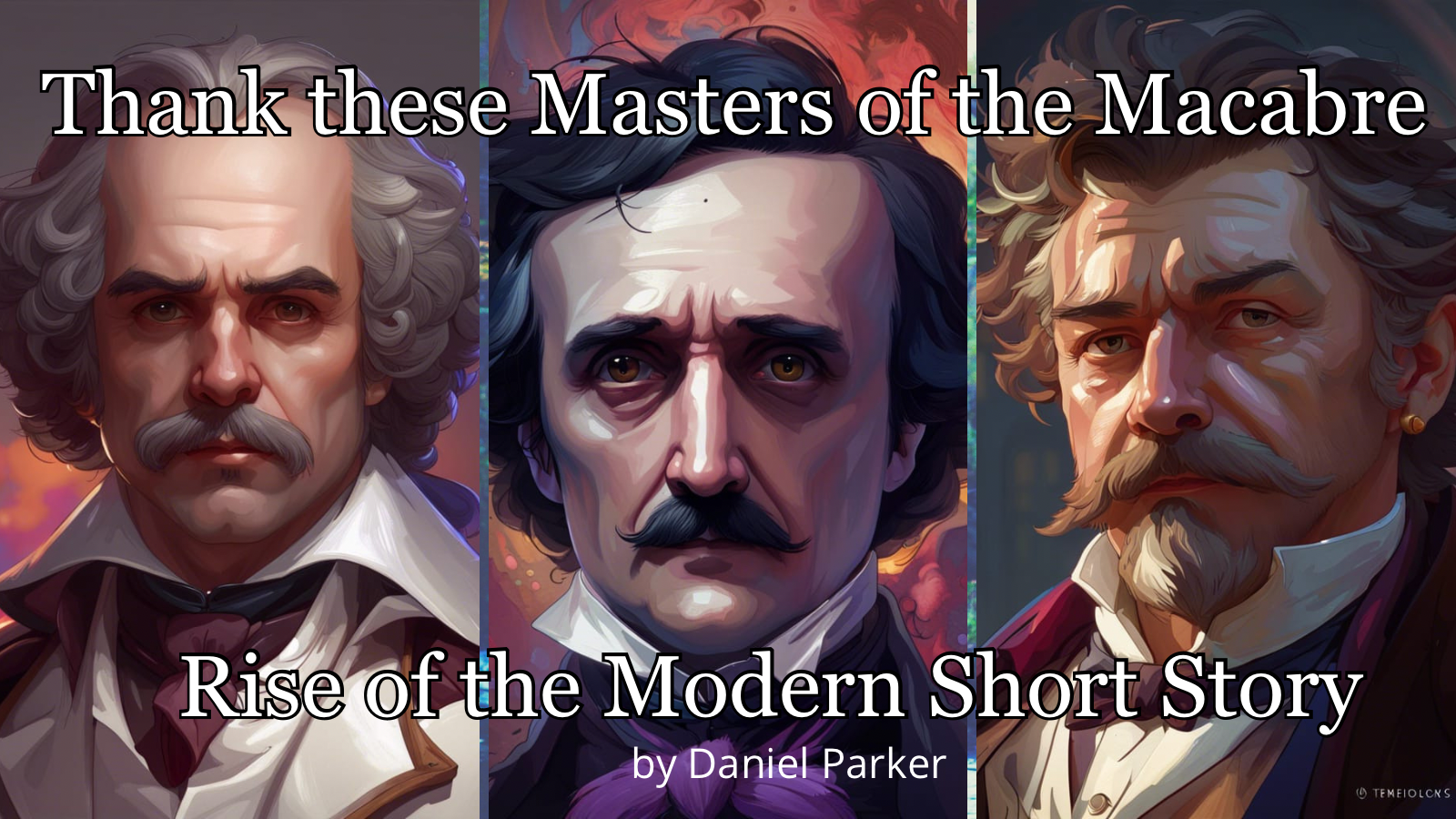
Thank these Masters of the Macabre for the Rise of the Modern Short Story

Posted on October 17, 2023October 17, 2023 by Richard

The 19th century was a transformative era for literature, marked by the emergence of the modern short story as we know it today. During this period, writers brought new depth and complexity to the form, refining it into a compelling and concise medium for storytelling. Let’s journey back in time to explore the pivotal figures and literary milestones that shaped the rise of the modern short story.

Edgar Allan Poe: The Pioneer of the Macabre

One cannot embark on a discussion of the modern short story without paying homage to Edgar Allan Poe. Often regarded as the master of the macabre and the mysterious, Poe’s influence on the genre is immeasurable. His tales, including “The Tell-Tale Heart” and “The Fall of the House of Usher,” are celebrated for their psychological depth, eerie atmospheres, and intricate plots.

Poe was a pioneer of the modern short story, crafting narratives that left readers in suspense and awe. In “The Tell-Tale Heart,” he delved into the mind of an unreliable narrator, exploring themes of guilt and madness. “The Fall of the House of Usher” created an atmosphere of dread and decay that has since become a hallmark of Gothic storytelling. Poe’s stories exemplify the ability of the short story to create a powerful impact in a compact space.

Nathaniel Hawthorne: Unveiling the Darker Aspects of Humanity

Nathaniel Hawthorne, another American writer of the same era, made significant contributions to the modern short story by exploring the darker aspects of human nature and societal norms. His tales, including “Young Goodman Brown” and “The Minister’s Black Veil,” delved into moral ambiguities and psychological complexities.

In “Young Goodman Brown,” Hawthorne delved into the concept of moral hypocrisy and the loss of innocence. The story, set against the backdrop of the Salem witch trials, presents a journey into the heart of darkness and raises questions about the inherent nature of evil. “The Minister’s Black Veil” introduced the enigmatic figure of a minister who shrouds his face with a black veil, becoming an embodiment of hidden sins and the human tendency to conceal one’s true self. These themes would later become central to the modern short story’s identity.

Guy de Maupassant: Mastering the Art of Brevity

In France, Guy de Maupassant gained recognition for his mastery of the short story form. His tales, such as “The Necklace” and “The Horla,” exemplify the art of storytelling within the constraints of brevity. Maupassant’s ability to create well-developed characters and intricate plots in a limited space set a standard for the modern short story.

“The Necklace” is a poignant exploration of the consequences of pride and social aspirations, revealing the tragic irony of a woman who borrows what she believes to be a valuable necklace, only to discover that it was a fake. “The Horla” ventures into the realm of psychological horror and the unknown, as the protagonist grapples with a malevolent and invisible presence. Maupassant’s stories, renowned for their compact yet powerful narratives, played a pivotal role in shaping the modern short story’s ability to convey depth and complexity in a concise form.

Anton Chekhov: A Revolution of Subtlety and Ambiguity

While the 19th century introduced several masters of the short story, it was Anton Chekhov who revolutionized the form in the late 19th and early 20th centuries. Chekhov’s stories, including “The Lady with the Dog” and “The Cherry Orchard,” were characterized by a focus on everyday life, the exploration of complex characters, and the absence of neatly resolved conclusions.

“The Lady with the Dog” is a masterpiece of character exploration, delving into the complexities of love, desire, and the human condition. Chekhov’s ability to portray characters with authenticity and nuance set a new standard for character development in short fiction. “The Cherry Orchard,” while a play, encapsulates the essence of Chekhov’s storytelling—moments of profound depth, human foibles, and the absence of definitive conclusions. His work greatly influenced the modern short story and its embrace of subtlety and ambiguity.

The 19th century’s literary giants—Poe, Hawthorne, Maupassant, and Chekhov—left an indelible mark on the modern short story. Their narratives, whether shrouded in mystery, exploring the darker aspects of humanity, mastering brevity, or embracing subtlety and ambiguity, set the stage for a form of storytelling that would continue to captivate readers for generations to come.

The modern short story owes its ability to convey profound ideas, evoke emotions, and engage readers in a compact narrative to these pioneering authors. As we explore the richness of contemporary short fiction, we must pay homage to these 19th-century innovators who crafted tales that continue to resonate and inspire writers and readers worldwide. In their mastery of the short story, they exemplify the age-old adage: “Brevity is the soul of wit.”

###

Danial Parker has a Master’s in Science from the University of Michigan. He has just started to break into the literary world.

  • Author
  • Recent Posts
Richard
Richard
Richard Everywriter (pen name) is the founder of EveryWriter and a 25-year veteran of the publishing industry. With degrees in Writing, Journalism, Technology, and Education, Richard has dedicated two decades to teaching writing and literature while championing emerging voices through EveryWriter's platform. His work focuses on making literary analysis accessible to readers at all levels while preserving the rich heritage of American literature. Connect with Richard on Twitter  Bluesky Facebook or explore opportunities to share your own work on ourSubmissions page. For monthly insights on writing and publishing, subscribe to our Newsletter.
Richard
Latest posts by Richard (see all)
  • Six Words of Halloween Nostalgia: The 2026 Contest - August 31, 2026
  • Six Words, Six Feet Under: The 2026 Halloween Horror Contest - August 31, 2026
  • THE VAMPIRE by Rudyard Kipling - August 31, 2026
Related Posts:

  • a typewriter, how long is a short story
    How long is a short story? A question for the ages
  • moneykey
    Simple New Ways for Writers to Make Money!
  • Should You Ever (ever) Pay to Have Your Work Read?
    Should You Ever (ever) Pay to Have Your Work Read?
  • books
    Awards Writers Should Know
Category: Articles On Writing

Leave a Reply Cancel reply

Your email address will not be published. Required fields are marked *

AD


Writer’s Contest

A New Venture

Get the magazine and free books

When you sign up you get 2 free horror ebooks and digital copies of our magazine for free!


Can you believe this?

Latest

  • Julie Shackman on Six Words of Halloween Nostalgia: The 2026 Contest: “Black front tooth and green hair” Oct 6, 09:19
  • Julie Shackman on Six Words, Six Feet Under: The 2026 Halloween Horror Contest: “Why is that disconnected phone ringing?” Oct 6, 09:12
  • Jules Roscoe on Six Words, Six Feet Under: The 2026 Halloween Horror Contest: “My reflection has too many teeth.” Oct 5, 14:39
  • Jules Roscoe on Six Words, Six Feet Under: The 2026 Halloween Horror Contest: “That thing is not my son.” Oct 5, 14:35
  • Liam Hlad on When Edgar Allan Poe Fails the AI Detector: “Humanity is done for.” Oct 5, 13:10
  • J. J. Hillard on Six Words, Six Feet Under: The 2026 Halloween Horror Contest: “Detailed torture instruction video by AI.” Oct 5, 12:54
  • Cliff Saunders on Six Words, Six Feet Under: The 2026 Halloween Horror Contest: “The witch ate my heart–poooff!” Oct 4, 08:06
  • Katie Turner on Six Words, Six Feet Under: The 2026 Halloween Horror Contest: ““The bill is one million dollars!”” Oct 2, 16:57
  • Katie Turner on Six Words, Six Feet Under: The 2026 Halloween Horror Contest: “Blood streaked his face. “What happened?”” Oct 2, 16:09
  • Katie Turner on Six Words, Six Feet Under: The 2026 Halloween Horror Contest: “The planet burst. No more home.” Oct 2, 16:06

Search

Featured Classic Work

The Call of Cthulhu by H.P. Lovecraft

Around our site

  • Writing Prompts
  • Writing Tips
  • Contests for writers
  • Submissions
  • Stories
  • Poetry
  • Literary Magazines
  • Book Publishers
  • Newsletter

New Poetry

Blindsight by Julie Dexter a poem

J.M Summers’ New Poem Crocuses

New Short Stories

1979, Hungary By Zary Fekete

Read 1979, Hungary By Zary Fekete

Damn if You Do…by R.S. Nelson

Damn if You Do…by R.S. Nelson


Most Liked

  • pictures of 4 famous poetsTop 10 Types of Poems, Forms or Formats +185
  • A scary picture of a girl reaching out10 Horrifying Horror Story Prompts +45
  • 1000 Greatest Short Stories of All Time1000 Greatest Short Stories of All Time +42
  • Stack of magazinesTop 50 Literary Magazines -Every Writer +29
  • 50 Word Horror Story Contest 202450 Word Horror Story Contest 2024 +24
  • $100 50 Word Horror Story Contest +22
  • no-thumbnailGetting Up On Cold Mornings by Leigh Hunt +17
  • Continue the Story +16
  • 100 Screenwriting Ideas to Get You Writing100 Screenwriting Ideas to Get You Writing +15
  • How to protect your writing from theftHow to protect your writing from theft +12
© 2026 EveryWriter | Powered by Minimalist Blog WordPress Theme
We use cookies on our website to give you the most relevant experience by remembering your preferences and repeat visits. By clicking “Accept”, you consent to the use of ALL the cookies.
Do not sell my personal information.
Cookie settingsACCEPT
Privacy & Cookies Policy

Privacy Overview

This website uses cookies to improve your experience while you navigate through the website. Out of these cookies, the cookies that are categorized as necessary are stored on your browser as they are as essential for the working of basic functionalities of the website. We also use third-party cookies that help us analyze and understand how you use this website. These cookies will be stored in your browser only with your consent. You also have the option to opt-out of these cookies. But opting out of some of these cookies may have an effect on your browsing experience.
Necessary
Always Enabled
Necessary cookies are absolutely essential for the website to function properly. This category only includes cookies that ensures basic functionalities and security features of the website. These cookies do not store any personal information.
SAVE & ACCEPT